Keith was a cowboy. Cattle and horses were all he knew growing up. And the US Navy. But he earned his living from raising cattle and horses. He bred and raised Appaloosas. When I knew him, he also ran cattle on the open range in Oregon. Keith married up and well. Bon Nelle was a lady, well-educated, and a medical professional. Keith and Bon Nelle had two daughters, Kay and Connie. They were like their mother and lived with grace, intelligence, and kindness.
Earning a living in rural Oregon was a struggle. Raising cattle and horses is some of the hardest work one could choose, and it does not pay well. But Keith bought property, built a small house, and made a hard-scrabble living for those three ladies. The only time I heard him complain was when a mean stud bit a chunk out of his shoulder.
In Keith’s home three beautiful ladies blossomed. It is a great credit to him that he loved them well.
Keith was a real man. A good man, husband, and father.
Tommy was a carpenter and made his living doing small remodel jobs for folks he knew. In the town where we lived, most work came from those who knew you, from your community. So friendship was not a luxury, it was essential to life.
Tommy was my father’s friend. And that meant much more than the meaning popularized by Facebook. When either man was in need, the other was there. They often teamed up on jobs requiring both carpentry and plumbing.
After my father died, Tommy took a special interest in my mother. Not the kind of interest that would grab headlines today. He continued to be a friend of my father by looking in on my mother and by “doing for her” when he could. Many times my mother would say, “Tommy was over here today and fixed the door (or fence or roof, etc.).” I once thanked Tommy for helping my Mom, but he seemed taken aback as if he was not doing her a favor, but a duty out of love. With shock still on his face, he told me, “Well, she is my sister!” And that meant a lot coming from a man for whom family was everything.
Tommy was also my friend. He was a real man. A kind man. And I miss him keenly.
After too much hard work outdoors, it was a cold, tired, end-of-the-day. The winter clouds were threatening snow. We were both looking forward to a hot shower, coffee, and a meal.
Frank (my father) was a plumber. I worked for him during my high school years. He needed the help and I needed the money. But I was happy to work with my Dad because he was one of the best craftsmen in our county. I learned a trade from him.
Plumbers in those days did not earn what they do now. His income was enough for us to have a home and eat three meals daily. But we were a one-income family and our standard of living was on the lower end of middle class with most other blue-collar workers.
On the way home from that very tiring day, Dad pulled into a gas station to fuel up for the next day’s work. Standing next to the office was a poor, young couple traveling to a distant place. They too were cold. And they were in need—not begging mind you—but obviously in need. Dad had an eye for that. He had been in a similar position earlier in life.
While the tank was filling, he spoke quietly to them and then handed them the contents of his wallet, suggesting they get a hot meal, a room, and gas for their car. I did not see the interaction nor did Dad say anything about it to me. I only learned of it from my mother much later. He told her, not to gain praise, but to explain where their money had gone. It amounted to a good share of that week’s profits.
I first met Curt at the Naval Air Station, Pt. Mugu, in 1975. He was trim and fit in his dress khakis and full of energy and enthusiasm. Curt was a Lieutenant Commander and a Navy Chaplain, but—as I soon learned—no ordinary man.
Curt began his Naval career as an enlisted man. Just after basic training, he married his sweetheart, Shirl. While overseas, God called him to become a minister of the Gospel. He left the Navy and went to college and seminary while serving in churches, driving a school bus, and working night shift in a factory. Curt had no idea when he slept. After graduation from seminary, he was ordained as a minister of the Gospel and rejoined the Navy, this time as an officer. He was told there were no more billets available in the Chaplain Corps, but he persisted. And his persistence was rewarded.
Curt was assigned to the 3rd Battalion, 5th Marines, and began training with them at Camp Pendleton. He went to war in Viet Nam. He was with the battalion in combat. He served in the rice paddies with those young men. Curt held some as they died. He preached the Gospel to the living.
Curt did not have to go into combat. It would have been easier and safer back home or in Saigon. But he chose the hardest duty of all. His family worried. So did Curt.
After Viet Nam, Curt returned stateside to his family and was seldom parted from them. But it was not long before they lived around the world, in the Philippines and Japan. Curt and Shirl raised three magnificent children, two daughters and a son.
Curt was a man who chose the most difficult road. Like the Marines he served, he ran toward the sound of gunfire, not away from it. Curt was a good man. A man’s man.
There are events in a man’s life when one glimpses his true character as the long-hidden sun shining briefly from behind a cloud. Those glimpses often coincide with a crisis when the stuff of everyday life is stripped away.
George was an old man when I first met him. He welcomed me into his apartment wearing a tattered sweater. George was worn down with years, a shrunken image of what he had been in his prime. But there was a hint of something bigger, younger, and stronger about him.
His wife of 50-some years suffered from a physically and mentally debilitating disease. When I met her, she could no longer walk. George gladly pushed her wheelchair and took her where she wanted to go. As the disease progressed, George became her full-time caretaker. His heart never wavered.
I visited George in his wife’s last days. He was profoundly sad. When I commented on the kindness with which he cared for her he fixed my gaze. He was silent for a time, perhaps remembering old vows. Then his lips turned up in a slight but confident smile. And he said, “That is what I signed up to do.”
George was only following his Master who “having loved His own who were in the world, He loved them to the end.” (Joh 13:1 NAS)
I first saw the Latin inscription, BEATUS VIR, above the Bishop’s stall in the choir of Lincoln Cathedral during Evensong in 1991. My halting translation then was “Blessed Man.” I thought it was an attribution to the bishop. I was wrong. They are the first words of Psalm 1 in Latin translated in English as “Blessed is the man….” The first words of each Psalm are carved around the choir beginning with the bishop’s stall. But I always hoped that the Bishop should be a good man.
Is there such a thing as a good man? One might doubt it after hearing of so many celebrities and politicians who surrendered their virtue, their manliness, to the unholy trinity of Power, Mammon, and Eros. They now live as castaways, flotsam on a littered sea.
But I have known a few good men who never sold their birthright, who did not “hold their manhoods cheap.”
In subsequent posts, I will tell the stories of George, Curt, Frank, Keith, Bill, and Billy. These were men not much esteemed by the world; fame did not come their way (with one exception). They were little known in their time, but like God’s men and women of old, “God is not ashamed to be called their God” (Heb 11:16 NAS) and these were “men of whom the world was not worthy” (Heb 11:38 NAS).
This blog has been on hiatus since June of 2020. In the intervening years there have been three or four life-interrupting events, chief among them Curt Brannan’s failing health and death.
I began this blog, not because I thought I had something exceptional to say, but because of my father-in-law, Curt Brannan, and his fervent desire to continue active ministry as he aged. I suggested co-authoring a blog and he was excited.
Decades before, Curt had written a short weekly devotional for his church. The articles were so popular that a family member collected and bound them. Selections from that trove became his contributions to this blog.
At one point Curt told me he could not continue, and it was not long after that his health deteriorated rapidly and, for a time, my wife and I became his caretakers.
During those intervening years, we had the care of my mother who had dementia. I also retired (for the second time). Nancy and I built a new home in Washington State and relocated there in 2022. I can say now that those big life events have settled down.
Though Curt is gone, I intend to restart this blog on a relaxed but regular schedule to simply honor him. He was my friend. He gave me his wonderful daughter. He was a real man, a man’s man.
The eight posts that follow this are about real men I have known, men who loved and humbly served their Lord. Curt is one of them.
Jesus was on his way to Jerusalem. He was on a mission from his Father. His was the most pressing and important business in human history. Timing was critical. If you or I had been given such a mission from God, we would not have stopped.
The large, central portion of Luke’s Gospel is called the Journey Narrative. It begins in chapter 9 in Galilee where Luke tells us “he set his face to go to Jerusalem.” But he did not go as the crow flies. His path took him through Samaria and eventually south to Jericho. By Luke chapter 18 He was on the last leg of his Journey to Jerusalem. And all along the way he had told his disciples that he was going there to die. They did not get it.
On the outskirts of Jericho, he was followed by a “great crowd.” And suddenly a voice rang out from the side of the road. Mark tells us the voice’s owner: Bartimaeus. And many in the crowd yelled back, “Shut up!” But he cried out even more, “Jesus, Son of David, have mercy on me!”
At that point Jesus could have continued walking. We probably would have walked on if we were on a mission as pressing and important as his. But thank God Jesus is not like us!
Jesus stopped. These are among the most important words in the Gospels! And these words are Good News for you and me. There was a crowd between Jesus and Bartimaeus, all hostile to his plea. But Jesus said, “Call him.” And Bartimaeus sprang up and came to Jesus. Jesus asked him, “What do you want me to do for you?” And Bartimaeus replied, “Master, let me recover my sight.” Jesus said, “Go your way; your faith has made you well.” And immediately he recovered his sight and followed him on the way.
Here is the lesson for us: if we cry out to Jesus for mercy, the Lord of all Creation will stop. He will stop and listen and act. He loves you and he loves me that much! What an astounding thought!
And did you notice Bartimaeus’ little disobedience. Jesus told him to go his way. Instead, he immediately followed Jesus on the way. He whose former occupation was begging was delivered. His new occupation was following Christ.
Never give up hope! Call out to Jesus from the side of whatever road you find yourself. If you cry out to him in your blindness and poverty for mercy, he will stop. He will hear. He will speak kind words. And he will heal you and set you free to follow him.
And he died in a good old age, full of days, riches, and honour.
1 Chr. 29:28 KJV
The Bible tells us that “as the heavens are higher than the earth, so are my ways higher than your ways, and my thoughts than your thoughts” (Isa. 55:9 KJV). We should not be surprised when our ideas are quite the opposite of the Lord’s.
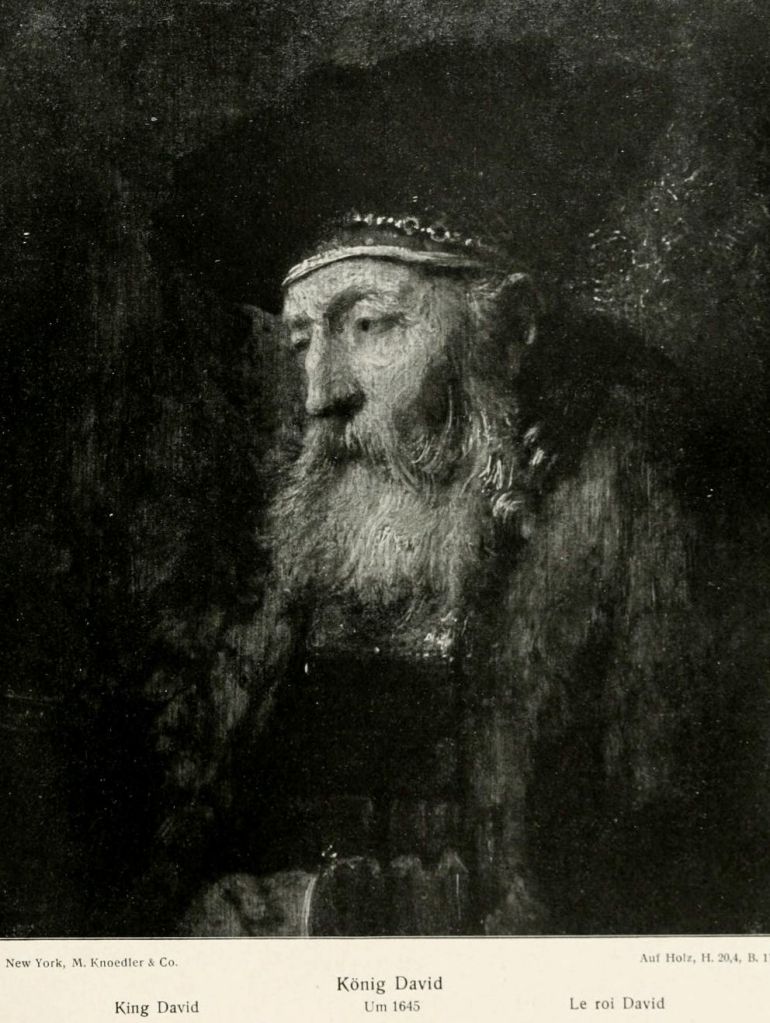
King David was about 70 years old when he died, but he had lived a hard life and toward the end he could not even keep warm. No doubt his many battle wounds pained him greatly in old age. He probably experienced old age as Shakespeare fashioned it, “sans teeth, sans eyes, sans taste, sans everything.”
It is easy for us to see old age as nothing but a succession of losses, a diminishing, a cruel game of chance in which death takes all. And in the West, we do not honor the aged as some other cultures do. So with loss of strength and ability comes also a loss of meaning. That is hard. That is our estimate of old age.
But God sees old age differently. His thoughts are not our thoughts. When the Lord looked at David—cold and in pain—He did not see loss. He saw accumulation! He called David’s old age “good.” And in His eyes David’s life was treasure. David once said, “in your book were written, every one of them, the days that were formed for me” (Ps. 139:16 ESV). To God, David was a vessel for God’s glory, full of the days God Himself had planned for him, each a testament to the Lord’s steadfast love.
 "E'en down to old age all my people shall prove
my sovereign, eternal, unchangeable love;
and when hoary hairs shall their temples adorn,
like lambs they shall still in my bosom be borne.
K., How Firm a Foundation (1787)
Prayer: O Lord, let us see the elderly with your eyes, that they are your special treasure. Amen.









 This Mind