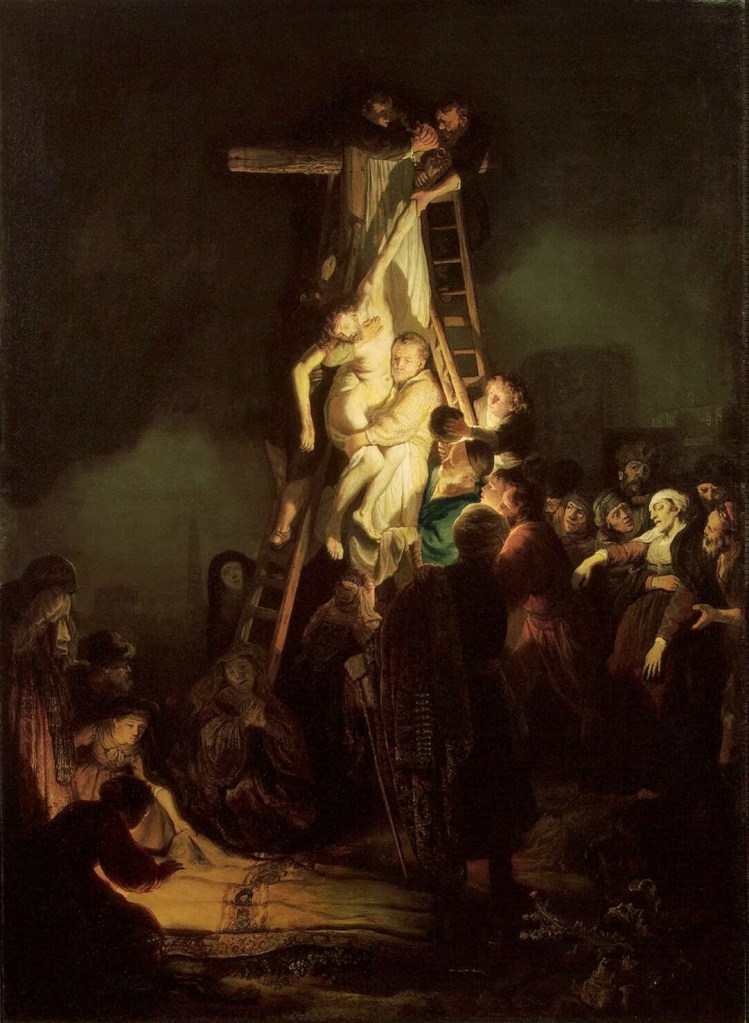
What language shall I borrow to thank Thee, dearest friend,
For this Thy dying sorrow, Thy pity without end?
–Bernard of Clairvaux
What language shall I borrow to thank Thee, dearest friend,
For this Thy dying sorrow, Thy pity without end?
–Bernard of Clairvaux

If anyone comes to me and does not hate his own father and mother and wife and children and brothers and sisters, yes, and even his own life, he cannot be my disciple.
Luke 14:26 ESV
[From a sermon by the Rev. Eric Irwin, Covenant Presbyterian Church, Issaquah. See link at end.]
In the middle of verse 26, among the people you are supposed to hate is yourself, your own life. The most insidious form of self-love is thinking highly of ourselves and poorly of others. That’s my own sin.
That is why it is one of the first things that Paul addresses in Philippians 2: “In humility, count others more significant than yourselves.” But there’s another facet of self-love in things like the coronavirus, where there is just so much fear.
To hate your life means that you don’t live primarily to protect your life. That’s not the reason you’re here. Rather, you live, in Paul’s words, for the praise of His glorious grace, the praise of His glory, or just for His glory. It’s the simple idea of the first question-and-answer in the shorter catechism. It doesn’t mean you should be reckless with your life. But it does mean staying alive is not an ultimate good. Staying alive is not in itself an ultimate good!
The ultimate good is how your life is used, for the glory of God, how you spend it. If you get the coronavirus and die, taking care of other people, that’s a life well spent and, in a way, a happy death. There’s nothing wrong with that. Our primary mission is not just to protect ourselves, its to make sure our lives are instruments in God’s hands.
You don’t have to be foolish. I personally would not get on a cruise ship right now. I would not get on a cruise ship with an elderly parent right now. But staying alive is not the ultimate good. The glory of God is the only ultimate good, renouncing everything—everything!—to be His disciple.
https://cpcissaquah.org/sermons/christ-in-the-highest-place-pt-2/
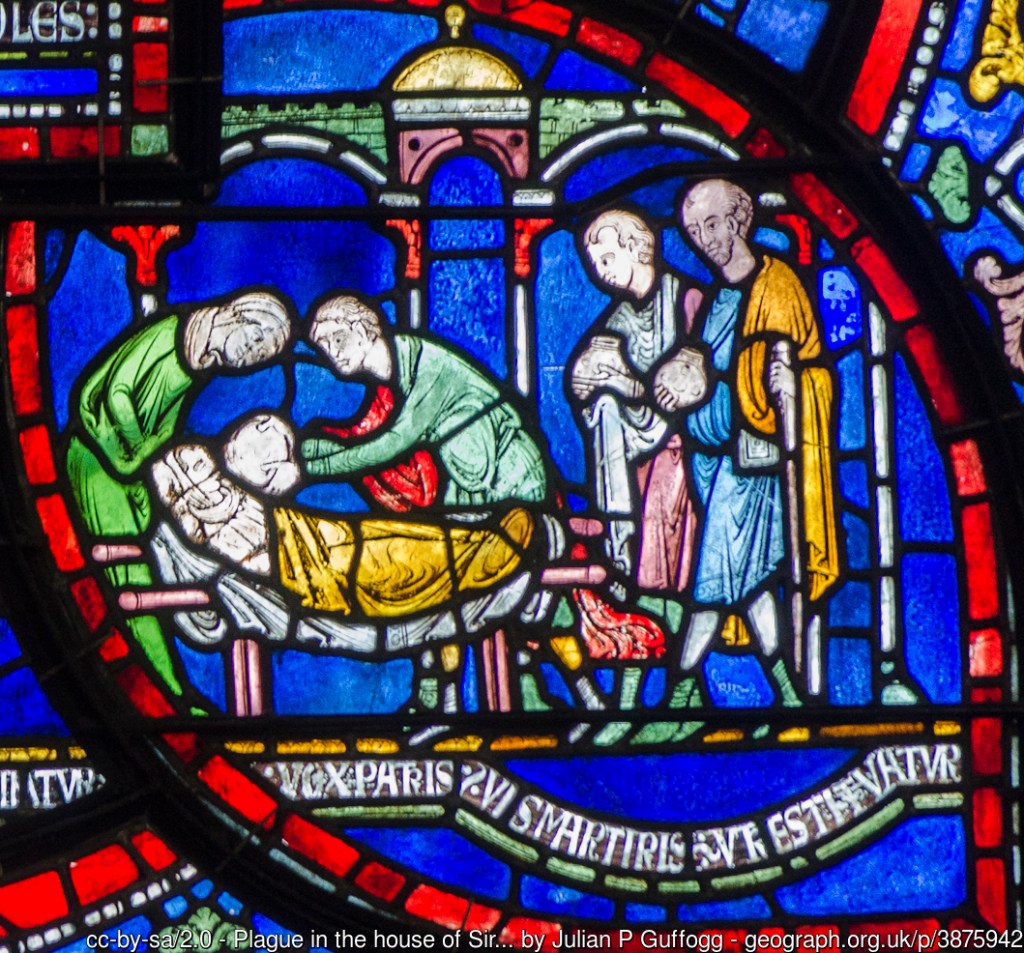
In the middle of the third century A.D. a plague appeared in the city of Alexandria that was to sweep west across Africa and north into the heart of the Roman empire. According to Kyle Harper (The Fate of Rome: Climate, Disease, and the End of an Empire, Princeton University Press, 2017) the plague exhausted the reserves of the empire and hastened its fall. Accounts are sketchy, but such evidence that does exist suggests the pathogen may have been an Ebola-like filovirus. The plague progressed through the empire like a slow-burning fire, leaving dust and ashes in its path. The population of Alexandria fell by more than half. It was a time of profound fear and death.
Dionysius was the bishop of Alexandria when the plague began. He tells us of the great fear that gripped the citizens of the city.
The pagans thrust aside anyone who began to be sick, and kept aloof even from their dearest friends, and cast the sufferers out upon the public roads half dead, and left them unburied, and treated them with utter contempt when they died.
Alvin J. Schmidt (How Christianity Changed the World, Zondervan, 2004)
But how different the response of the Christians! Dionysius says,
[V]ery many of our brethren, while in their exceeding love and brotherly kindness, did not spare themselves, but kept by each other, and visited the sick without thought to their own peril, and ministered to them assiduously and treated them for the healing in Christ, died from time to time most joyfully…drawing upon themselves their neighbors’ diseases, and willingly taking over to their own persons the burden of the suffering of those around them.
We also live in a time of plague. It is yet to be seen how widely the coronavirus will spread and how deadly it might become. But fear is already on our doorstep. Should the follower of Christ fear this contagion like the world around him? Should he panic with the crowd? If the Christians of third-century Alexandria are an example to us, we should face the prospect of plague not with fear, but with a confident joy.
What? That sounds insane!
But it is not. Arguably the most frequent command from God to man in Scripture is “Do not fear!” or “Fear not!” It occurs about 70 times in the Bible. Perhaps it is so common because fear is our default response to trouble and the unknown. But the Christians of Alexandria were capable of joy because they did not fear. They knew that their Lord Christ had been given all authority in heaven and on earth and their times were in His hands and no other’s. They knew Christ had called them to love their neighbors, and they knew that such love would always be costly. Instead of fear, they were filled with the joy of their Master who gave His life for them.
The Romans thought the Christians of Alexandria were weak fools. God had a very different estimate of their worth. And the example they set ushered in generations of new converts to Christ.
Fear not!

He will tend his flock like a shepherd; he will gather the lambs in his arms; he will carry them in his bosom, and gently lead those that are with young.
Isaiah 40:11 ESV
I once raised sheep. And I know this: a shepherd expects the sheep to pull their weight. He expects them to walk on their own. He expects them to graze without instruction. He expects them to take care of their lambs without his help. You might call that a works-based culture.
And if a sheep begins to fail, for whatever reason, you might expect the sheep to think—if it could think—that it had failed its Master, that it was now useless, and needed to “get with the program” and try harder.
But, no, Jesus is not that kind of Shepherd. When a sheep can no longer carry out its sheeply function because of injury, condition, or age, He does not say, “You useless sheep!” He picks that sheep up and carries it.
The sheep is never useless to the Shepherd. It is loved and cared for. It may not be able to do what it once did; it may think its best days of service are over. But the Shepherd knows otherwise. And He has purposes for the sheep it cannot imagine.
So, friend, if you find you can no longer do what you once so easily did, do not despair. Do NOT think you are useless! You have moved from one stage of life in which you were naturally productive to the next in which you are the closest to the Shepherd’s heart.
And that is the best place to be!
Image: Public Domain, https://commons.wikimedia.org/w/index.php?curid=4502600

Paul, an apostle of Christ Jesus by command of God our Savior and of Christ Jesus our hope
1 Tim. 1:1 ESV
Little Sarah asks her Mom, “When is Daddy coming home?”
“Later today, Sweetheart,” says her Mom.
“I hope he will bring me a present!”
Mom smiles. “He always does, Sarah.”
And then the moment arrives. Dad opens the front door and little Sarah leaps from her toys, runs, and exclaims at the top of her voice, “Daddy, Daddy, Daddy!”
Dad drops his bags and lifts her into his arms where she giggles with delight and he smiles and tells her he loves her.
So what was little Sarah’s hope? That her Daddy would bring her a present? No, it is probably better to ask, “Who was little Sarah’s hope?” You see, her hope was all bound up in her Daddy.
As he opens his letter to Timothy, Paul does not say we hope in something, but we hope in someone, Christ. Why? Because all God’s promises—the basis for all our hope—are bound up in Christ. Those promises and their fulfillment are inseparable from Him! Without Him, none of God’s promises are ours.
Sometimes we must become like a child to understand and live the deepest truth. Hope is like that.
For you, O Lord, are my hope, my trust, O LORD, from my youth.
Ps. 71:5 (ESV)
Photo by Josh Willink from Pexels.

We have this as a sure and steadfast anchor of the soul, a hope that enters into the inner place behind the curtain
Hebrews 6:19 ESV
“I hope the Tigers win the national championship!”
“I hope it doesn’t rain tomorrow!”
“I sure hope I get that job!”
Hope in our culture is usually associated with wishful thinking. We hope for things that just aren’t guaranteed.
Who has not heard the young employee briefing a senior executive on a project say, “We hope to get it done on schedule and under budget,” only to hear these damning words: “Hope is not a strategy! Give me something more solid next time!”
Of the three theological virtues—faith, hope, and love—it is hope that we view as the weak sister. We think of faith as solid and certain as we sing,
How firm a foundation, you saints of the Lord,
is laid for your faith in his excellent Word!
And we know love is unconquerable.
Love is strong as death (Sol 8:6)
The greatest of these is love (I Cor. 13:13)
But what about hope? It seems about as solid as mist. Is the Christian’s hope just wishful thinking?
Never! Though the outcome of the next football game, tomorrow’s weather, and results of a job interview are dependent on factors out of our control and even unknown to us, the Christian’s hope is very different. We might say that hope is only as certain as its object. We should also say that hope is no less certain than its object. Christian hope has as its object the promises of God. And He is the strong guarantor of those promises.
Wrap your mind around this: our hope in Christ is more solid and real than is the world around us because of the One in Whom we hope. Our hope is a “sure and steadfast anchor of the soul.”
Photo by David Troeger on Unsplash.

So now faith, hope, and love abide, these three.
1 Cor. 13:13 ESV
The apostle Paul was not alone in grouping the three so-called theological virtues—faith, hope, and love—together. The writer of Hebrews (Heb. 6:10-12) and the apostle Peter (1 Peter 1:21f) did the same. (Paul did it again in Rom. 5:2-5, Gal. 5:5f, Col. 1:4f, and 1 Thess. 1:3 and 5:8). The early church used to speak of these three virtues in the same breath.
But does the modern church keep that practice? A visit to the website SermonAudio.com shows almost 150,000 sermons available on the topics of either faith, hope, or love, but only 897—less than 1%—on all three.
A search of Christian books listed by Amazon with “Faith” or “Love” in the title show each has about a 45% market share. Hope comes in last with about 10%. Again, less than 1% of those books have all three virtues in the title.
Why is hope the neglected sister of the three daughters of virtue? Why do faith and love get most of the attention? Do they even belong together?
Paul gives us a strong clue in 1 Cor. 13:13. In the Greek text, the verb translated “abide” is singular (grammarians wince!) Literally, the verse reads, “So now faith, hope, and love abides, these three.” Paul was not guilty of an error in grammar, but he did treat the three virtues as a unity. They should not be separated.
We often measure Christian maturity in terms of faith first. “John sure knows his Bible! He is one of the strongest Christians in the church.” And we all know that faith without works is dead, so love gets top billing as well. “Sarah is a wonderfully mature saint. Have you seen how much time she spends helping the poor in our community?” But have you ever heard someone say, “Sam is an outstanding Christian: he overflows with hope.”
I think not. Next time we will spend some time with the neglected daughter of virtue, Hope.
Photo by Shumilov Ludmila on Unsplash

Then Isaac called Jacob and blessed him and directed him, “You must not take a wife from the Canaanite women.
Gen. 28:1 (ESV)
By the time Isaac was an old man and blind, his family was a hot mess. Esau spent his time hunting and carousing with the neighborhood women. Rebekah was vexed by them and said to Isaac, “I loathe my life because of the Hittite women. If Jacob marries one of the Hittite women like these, one of the women of the land, what good will my life be to me?” (If Mama ain’t happy, ain’t nobody happy!) And with his mother’s help, Jacob deceived his father into giving him the birthright blessing. To top it off, Esau was planning to kill Jacob.
You would think that after all this Isaac would be exasperated with every member of his family. But the deepest cut of all was Jacob’s scheming, conniving deception, the bond of trust utterly broken. Isaac had every right to send Jacob away and never speak to him again.
The startling piece of this drama is in verse 1 of chapter 28: “Then Isaac called Jacob [the creature!] and blessed him….” Isaac did not treat Jacob as he deserved. Instead, Isaac turned to Jacob with grace. That grace took root and grew so that Jacob could endure, in turn, the betrayal of his sons and still maintain his faith in God. At the end of his life, Jacob would speak of “…God before whom my fathers Abraham and Isaac walked, the God who has been my shepherd all my life long to this day.” (Gen. 48:15 ESV)
We have a choice when family hurts: we can react and confound the mess, or we can plant seeds of grace and trust God they will grow.

I will go to the altar of God, to God my exceeding joy, and I will praise you with the lyre, O God, my God.
pS. 43:4 esv
It is true we read very little of happiness in most English translations of the Bible. But we read a lot about joy. What’s that all about?
In the Old Testament the Hebrew words translated as joy or rejoice spring from solid foundations. A wise son gives joy (Prov. 15:20), kindness from others brings joy (Prov. 12:25), and meeting a loved one is a joyous occasion (Exodus 4:14). But by far the greatest source of joy in the Old Testament is God himself (see Ps. 5:11, 9:2, 16:9, 32:11, 40:16, etc.)
If there is a difference to be made between happiness and joy in the Christian, it may be that while happiness and pleasure arise from changing circumstances, real joy springs from an unchangeable source, God himself. Because that is true, it is possible for us to face a frowning world with joy in our hearts.
After all, we were made for this! The old Westminster catechism asks and answers this question, “What is the chief end of man?”
Man’s chief end is to glorify God, and to enjoy Him for ever.
wSc q1

How happy are those who know what sorrow means for they will be given courage and comfort!
Mt. 5:3 Philips
Our world obsesses about happiness. But the Bible talks very little about happiness, and when it does, it surprises us. The closest we get was out of the mouth of Jesus when he used the word makarios (blessed) in the Sermon on the Mount. Phillips translated makarios this way: “How happy are….”
But that happiness, whatever it is, is upside down. Those Jesus calls happy are not the wealthy, the powerful, and those at the top of the ladder. No, he calls those happy who are poor, who know sorrow, who are hungry and thirsty for goodness, who are merciful, who have suffered under the persecutor’s fist.
The happiness Jesus speaks of does not rise out of our circumstances. It does not appear when our stars align. Jesus speaks of happiness that comes from the hand of God. It is his blessing and grows strongest in the face of contrary winds.
Happiness comes not from the world around us but from God alone.
Savior, if of Zion’s city
John Newton
I, thro’ grace, a member am,
let the world deride or pity,
I will glory in thy name;
fading is the worldling’s pleasure,
all his boasted pomp and show;
solid joys and lasting treasure
none but Zion’s children know.
photo by ronsaunders47 Bent over with the wind
 This Mind