Enemies

Stephen Olford tells of a Baptist pastor during the American Revolution, Peter Miller, who lived in Ephrata, Pennsylvania, and enjoyed the friendship of George Washington. In Ephrata also lived Michael Wittman, an evil-minded sort who did all he could to oppose and humiliate the pastor. One day Michael Wittman was arrested for treason and sentenced to die. Peter Miller traveled seventy miles on foot to Philadelphia to plead for the life of the traitor. “No, Peter,” General Washington said. “I cannot grant you the life of your friend.” “My friend!” exclaimed the old preacher. “He’s the bitterest enemy I have.” “What?” cried Washington. “You’ve walked seventy miles to save the life of an enemy? That puts the matter in a different light. I’ll grant your pardon.” And he did. Peter Miller took Michael Wittman back home to Ephrata–no longer an enemy but a friend.

When we think of enemies, we tend to think of groups and not of individuals. If someone asks us, “Who are your enemies?” we are likely to think of those nation-states that hate the West—the old Soviet Union, the Chinese Communist party, or Islamic terrorists.

Seldom do you or I think of personal enemies—a relative, a neighbor, a co-worker, or a member of the homeowners’ association —who hates us and harms us without cause…until it happens! If we live long enough on this earth, we will encounter personal enemies who do us great harm.

The Apostle Paul certainly did. In his second letter to Timothy he warned Timothy saying, “Alexander the coppersmith did me much harm; the Lord will repay him according to his deeds.” (2Ti 4:14 NAS)

Paul does not tell us what harm came his way. When an enemy does us harm, it may be a betrayal that breaks up a family; it might be a malicious coworker who undermines us and we lose our job; it might be a relative who abuses a child dear to us; it might be physical or emotional abuse from someone who once professed love for us.

And when an enemy causes us “much harm,” we are traumatized. The scenes of that trauma play over and over in our minds. Trauma may take over and define our lives for a very long time. The harm goes on and on, disfiguring heart and soul. How do we avoid the trap of obsession? How do we avoid retaliatory hatred? How can our hearts be healed?

Jesus spoke about personal enemies in the Sermon on the Mount. He said everything we need to know:

You have heard that it was said, ‘You shall love your neighbor, and hate your enemy.’ But I say to you, love your enemies, and pray for those who persecute you in order that you may be sons of your Father who is in heaven; for He causes His sun to rise on the evil and the good, and sends rain on the righteous and the unrighteous. (Mat 5:43-45 NAS)

Jesus tells us to love our enemies. And love is not just a warm feeling. It requires action. But we are not often in a position, as was Pastor Miller, to do good to our enemy. The harm my enemy does puts distance between us. We may never see them again. Or our enemy is implacable and refuses to be reconciled and continues to do harm. It is then even more difficult to love them or bless them in practical ways. What to do?

The answer, I think, lies in Jesus’ second command: “pray for them.” But what to pray?

The most potent prayer anyone ever offered for an enemy is the one Jesus prayed from the cross. He prayed that his Father would forgive them. We must follow Jesus’ example. When God answers our prayer, it will be a great good to our enemies but, more importantly, healing for us.

I have an enemies list. Oh, not the kind President Nixon kept, but those for whom I pray. I pray the Father will forgive them, grant them repentance, give them better minds, redeem them, and reconcile them as brothers or sisters.

Let the healing begin!

I can no longer condemn or hate a brother for whom I pray, no matter how much trouble he causes me–Dietrich Bonhoeffer

Shepherds

And in the same region there were some shepherds staying out in the fields, and keeping watch over their flock by night.

And an angel of the Lord suddenly stood before them, and the glory of the Lord shone around them; and they were terribly frightened.

And the angel said to them, “Do not be afraid; for behold, I bring you good news of a great joy which shall be for all the people; for today in the city of David there has been born for you a Savior, who is Christ the Lord.

And this will be a sign for you: you will find a baby wrapped in cloths, and lying in a manger.

And suddenly there appeared with the angel a multitude of the heavenly host praising God, and saying, “Glory to God in the highest, And on earth peace among men with whom He is pleased.

And it came about when the angels had gone away from them into heaven, that the shepherds began saying to one another, “Let us go straight to Bethlehem then, and see this thing that has happened which the Lord has made known to us.”

And they came in haste and found their way to Mary and Joseph, and the baby as He lay in the manger. (Luk 2:8-16 NAS)

Abraham, Isaac, and Jacob were shepherds. Herding sheep was an honorable profession in their day, maybe the only profession.

Jacob, on his death bed, told Joseph, “God has been my shepherd all my life to this day.”

King David was a shepherd, and he claimed the Lord was his shepherd.

But by the time Jesus was born, shepherding had fallen to the bottom of the social ladder. Shepherds were considered unreliable and could not testify in legal matters. They were generally considered to be cheats and liars. Worst of all, they were considered unclean and were barred from entering the temple. They had no access to God! And that was ironic because shepherds provided many of the temple sacrifices.

What, then, is the significance of the appearance of the angelic host to the shepherds? The angels could have appeared over the temple in Jerusalem and announced their message to the rich and powerful. They could have appeared to Herod. But, no, they appeared to a bunch of very lowly shepherds.

Why?

The angel who first appeared told them, “Do not be afraid; for behold, I bring you good news of a great joy which shall be for ALL the people.” Jesus did not come to be the savior only of the rich and powerful, the privileged, and the few. He came to be king and savior of ALL. From the bottom to the top. Starting with shepherds.

When the shepherds went to the stable in Bethlehem, they had immediate access to God for the first time in their lives.

The birth of Christ is also truly good news to you and me. Whatever our station in life, be we ever so poor and ornery, we have access to God through Jesus, our Savior and King.

I wonder as I wander, out under the sky,
how Jesus the Savior did come for to die
for poor ornery people like you and like I;
I wonder as I wander, out under the sky.

God Comes To Town

Now in the fifteenth year of the reign of Tiberius Caesar, when Pontius Pilate was governor of Judea, and Herod was tetrarch of Galilee, and his brother Philip was tetrarch of the region of Ituraea and Trachonitis, and Lysanias was tetrarch of Abilene, in the high priesthood of Annas and Caiaphas, the word of God came to John, the son of Zacharias, in the wilderness.

And he came into all the district around the Jordan, preaching a baptism of repentance for the forgiveness of sins; as it is written in the book of the words of Isaiah the prophet,

“The voice of one crying in the wilderness, ‘Make ready the way of the Lord, Make His paths straight.

‘Every ravine shall be filled up, And every mountain and hill shall be brought low; And the crooked shall become straight, And the rough roads smooth;

‘And all flesh shall see the salvation of God.’” (Luke 3:1-6 NAS)

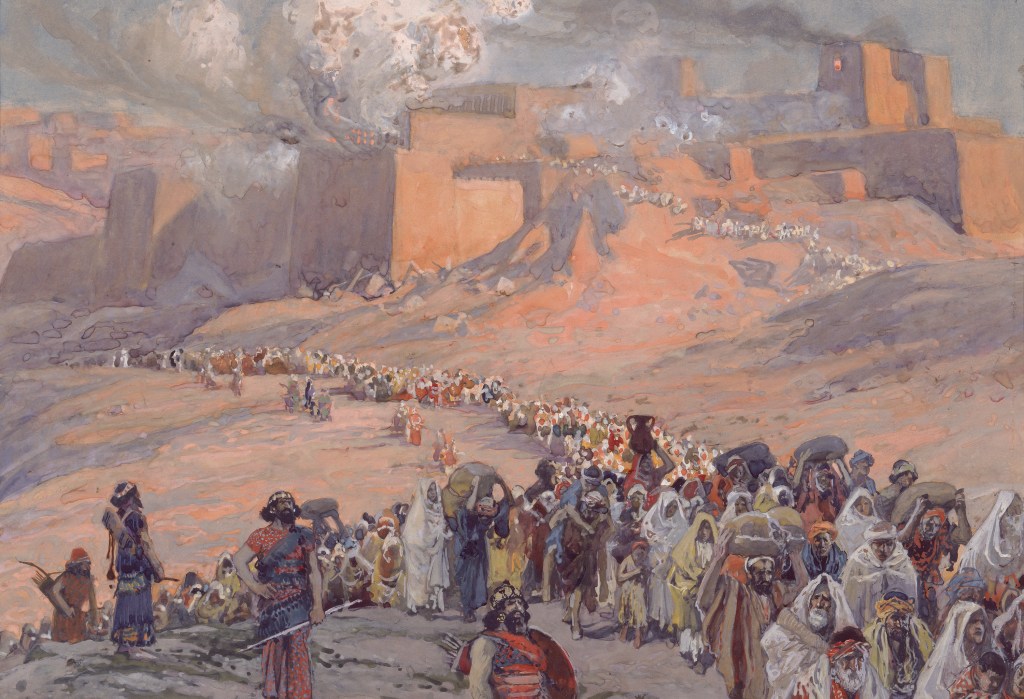
The prophet Isaiah wrote these words about John the Baptist 700 years earlier (Isaiah 40). By the time John the Baptist began preaching, Israel had been in captivity under the rule of successive foreign tyrants—the Babylonians, the Persians, the Greeks, and the Romans—for six hundred years.

The Jews felt God had abandoned them.

The last Old Testament prophet was Malachi and the last thing he said was,

Behold, I am going to send you Elijah the prophet before the coming of the great and terrible day of the LORD. (Mal. 4:5 NAS)

After Malachi prophesied God was silent for four hundred years. The Jews felt not only abandoned by God, but that He had stopped speaking to them.

That “Elijah” was John the Baptist and God’s 400-year silence ended when he opened his mouth. He was “the voice of one crying in the wilderness.”

And what did he say? God was coming to town! After six hundred years of foreign rule and four hundred years of silence.

God’s people did not have to go searching to find Him; He was coming to them. God always makes the first move in saving His people.

It is understandable that the Jews thought God had abandoned them and forgotten about them. But no! Through Isaiah the prophet God said this:

But Zion [God’s people] said, ‘The LORD has forsaken me, And the Lord has forgotten me.’ Can a woman forget her nursing child, and have no compassion on the son of her womb? Even these may forget, but I will not forget you. Behold, I have inscribed you on the palms of My hands. (Isaiah 49:16)

In John the Baptist, a prophet once more spoke. God broke His long silence when John announced loudly that God, the King, was coming back to His people and they needed get ready for Him.

In the birth of Jesus, God came back to town. The long captivity was over and, once again, God was speaking.

Have you ever uttered David’s prayer?

And my soul is greatly dismayed; But Thou, O LORDhow long? Return, O LORD, rescue my soul; Save me because of Thy lovingkindness. (Psa 6:3-4 NAS)

God may seem distant. He may have been silent. But do not think God has forgotten you. To you he says, “I will never leave or forsake you.” If you belong to Jesus, no one can snatch you out of the Father’s hand.

James Tissot, Public domain, via Wikimedia Commons

Immanuel

Young theological students glory in learning and saying the “omnis” of God: omniscience, omnipresence, and omnipotence. I know; I was one of them. But loving those words as abstract concepts is oceans away from knowing and loving the God who is everywhere present, knows all, and is almighty.

The children of Israel who were slaves in Egypt did not study academic theology. They probably had no terms equal to our “omnis.” But they were soon to learn them, not as abstract concepts, but as rubber-meets-the-road action. We read this in Exodus 2:

During those many days the king of Egypt died, and the people of Israel groaned because of their slavery and cried out for help. Their cry for rescue from slavery came up to God. And God heard their groaning, and God remembered his covenant with Abraham, with Isaac, and with Jacob. God saw the people of Israel—and God knew.

At the burning bush, God tells Moses,

I have surely seen the affliction of my people who are in Egypt and have heard their cry because of their taskmasters. I know their sufferings.

God heard…God remembered…God saw…God knew. And then God acted powerfully. What a marvelous and potent sequence.

One and a half thousand years later another exodus, another rescue, began. God’s people, under a yoke of slavery, cried out to him. God heard…God remembered…God saw…God knew. And God acted powerfully—omnipotently if you please—by sending his Son to bear our yoke of slavery for us and set us free.

This is Advent: God with us and the dawn of a new Exodus.

Humility

If your church has elected elders, you are familiar with the sermons on elders that usually precede their selection. A pastor will often preach from either 1 Timothy chapter 3 or Titus chapter 1 where the apostle Paul explicitly lists the qualifications for elders, now so familiar to us. But how many of us have heard such a sermon based on 1 Peter chapter 5?

In that chapter, we find the third place in the New Testament where an apostle describes an elder’s qualification. And in my mind, it is perhaps the most important but most neglected text on the subject. In 1 Timothy and Titus, Paul addresses the qualifications of elders to Timothy and Titus before they are appointed. Peter, on the other hand, speaks to existing elders about their responsibility, their behavior, and their character.

Peter says,

Therefore, I exhort the elders among you, as your fellow elder and witness of the sufferings of Christ, and a partaker also of the glory that is to be revealed,

shepherd the flock of God among you, exercising oversight not under compulsion, but voluntarily, according to the will of God; and not for sordid gain, but with eagerness;

“…nor yet as lording it over those allotted to your charge, but proving to be examples to the flock.” (1Pe 5:1-3 NAS)

Once they rise to office, too many elders act as if their chief responsibility were administration. The elders’ meetings are largely occupied by business matters, especially church finances. But Peter says the main occupation of an elder—that which consumes most of his time or energy—is shepherding, the care of souls. And the shepherd must assume the role of a servant, not a lord.

In the verses that follow, Peter uses either the verb or noun form of the word humble no less than three times:

all of you, clothe yourselves with humility toward one another, for God is opposed to the proud, but gives grace to the humble.

Humble yourselves, therefore, under the mighty hand of God, that He may exalt you at the proper time.” (1Pe 5:5-6 NAS)

One might rightly say that the preeminent qualification of an elder is humility.

How many times have we seen the opposite? An unhumbled elder will skew to administration, a humble man to service. An elder who is not humble will not care so much for the souls of others; a humble man will be a shepherd of souls.

In the Presbyterian Church of Scotland, the elders used to pair up and visit all families in the parish. They spent most of their time doing that. They would care for the poor, pray with those who were ill or suffering, and gently teach them, reminding them of the Gospel.

When was the last time an elder visited you to pray with you in your troubles?

Notice Pater does not address just elders. He says, “All of you, clothe yourselves with humility toward one another.” Humility is to be the character of every member of the church. How can one find humble leaders from the flock if the flock is not humble? How many church fights and conflicts would be averted if true humility reigned?

“Let this mind be in you which was also in Christ Jesus…”

He Knows My Name

The story of Hagar in Genesis 16 is both a tragedy and an example of God’s amazing grace.

You will remember that Abram had come off several high points: his stunning victory over the four kings of the east with only the men of his household (Genesis 14); God’s covenant and promise that he would have an heir and become the father of a mighty nation (Genesis 15). Not only that, he became the father of all who believe:

Then he believed in the LORD; and He reckoned it to him as righteousness. (Gen 15:6 NAS)

But in Genesis 16 we find Abram and Sarai many years after that promise still childless. Abram was in his mid-eighties and Sarai was in her seventies. Sarai considered her prospects dimming with each passing year and finally formed plan B: give her servant, Hagar, to Abram as a wife and claim the child as her own.

And it turned into one big, hot mess. Abram was silent and passive. Hagar, once she conceived, became uppity. Perhaps she taunted Sarai, “Neener neener I’m pregnant and you’re not!” And Sarai told Abram, “It’s all your fault!” Talk about marriage problems! And Abram, instead of taking this mess in hand, remained passive and told Sarai, “She is your maid; deal with her as you see fit.”

Sarai treated Hagar harshly and soon Hagar ran from her mistress and started back to Egypt.

Imagine being Hagar: she was a foreigner. She was a runaway slave. She was a pregnant woman on the run in the desert. Alone.

How could it get worse?

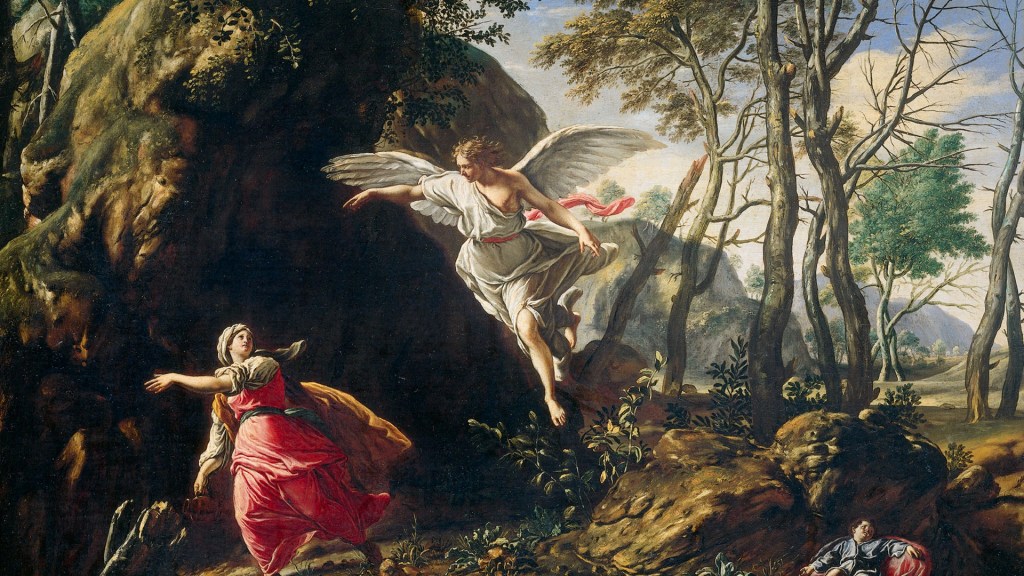
It is at that moment that the Lord intervened. Genesis says, “Now the Angel of the LORD found her by a spring of water in the wilderness, by the spring on the way to Shur.” Hagar was probably very tired and certainly scared. She may have been happy to meet a Protector.

The significance of this meeting in the desert is highlighted by two firsts. This is the first appearance of the Angel of the Lord in the Bible and, by that name, in history. Many believe him to be the pre-incarnate Christ. He comes full of grace to mend and repair all the wreckage caused by these three people. And he starts with Hagar. He will deal graciously with Abram and Sarai later.

It is also the first time in the Bible that someone gives the Lord a name. That an outcast, foreign slave should be the first one visited by the Angel of the Lord and the first one to name him is astounding.

But even more significant to Hagar was this: the Angel of the Lord knew her name. We might say, “Well, of course he did: he’s God.” But that is to miss the point. Hagar was stunned because this Angel knew her name. In her world, she was a nobody. And this Angel saw her in her desperate plight and treated her kindly!

Then she named the Angel El rohi, “the God who sees me.”

So, the Lord was gracious and kind to a rebellious nobody Gentile outcast wandering in the desert. He saw her and knew her name. She was not a nobody in the Lord’s eyes.

What is the message for us? Well, like Hagar, we are ornery and disobedient. We don’t deserve anything from God. We may think we are nobodies and say, “I’m just an old, worn-out has been” or “I’m just a little kid” or “Nobody knows who I am.” But in our misery and sin, the Lord sees us and will meet us in the desert or anywhere we have run to.

Share Hagar’s wonder: “He sees me! He knows my name!”