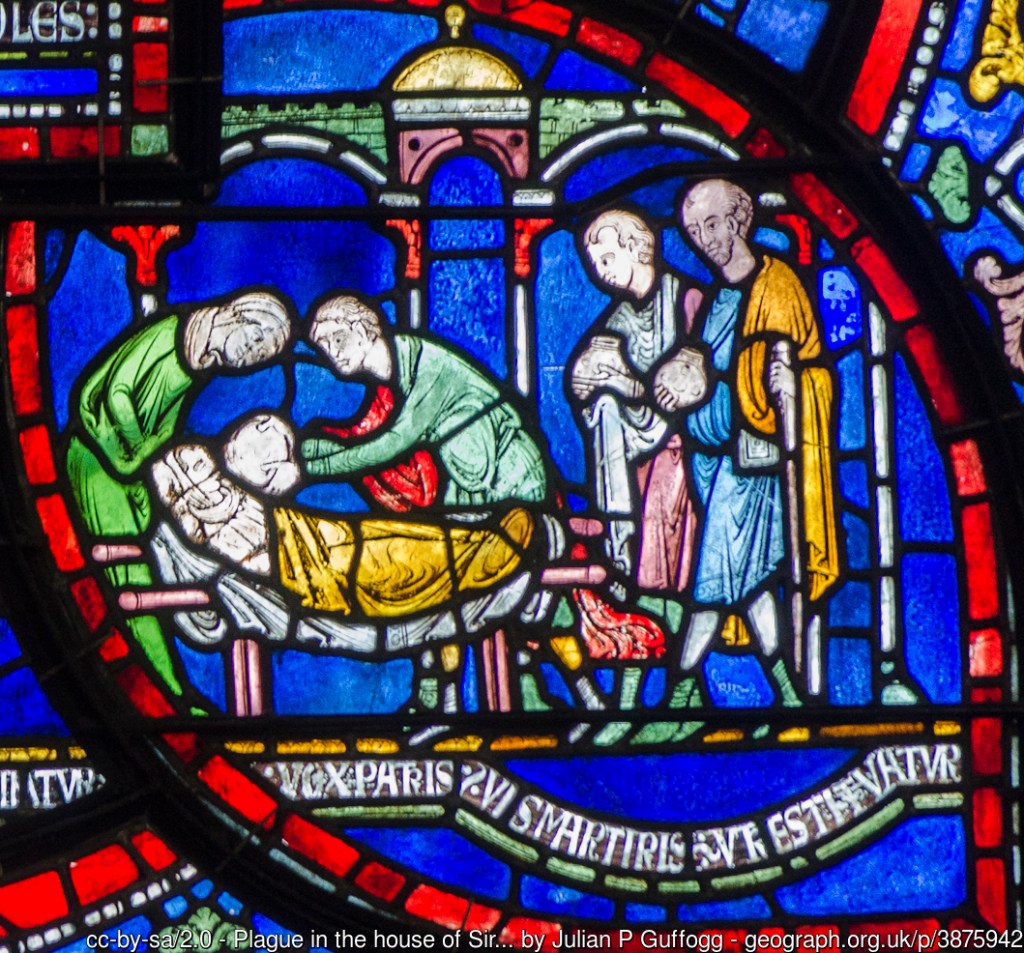
In the middle of the third century A.D. a plague appeared in the city of Alexandria that was to sweep west across Africa and north into the heart of the Roman empire. According to Kyle Harper (The Fate of Rome: Climate, Disease, and the End of an Empire, Princeton University Press, 2017) the plague exhausted the reserves of the empire and hastened its fall. Accounts are sketchy, but such evidence that does exist suggests the pathogen may have been an Ebola-like filovirus. The plague progressed through the empire like a slow-burning fire, leaving dust and ashes in its path. The population of Alexandria fell by more than half. It was a time of profound fear and death.
Dionysius was the bishop of Alexandria when the plague began. He tells us of the great fear that gripped the citizens of the city.
The pagans thrust aside anyone who began to be sick, and kept aloof even from their dearest friends, and cast the sufferers out upon the public roads half dead, and left them unburied, and treated them with utter contempt when they died.
Alvin J. Schmidt (How Christianity Changed the World, Zondervan, 2004)
But how different the response of the Christians! Dionysius says,
[V]ery many of our brethren, while in their exceeding love and brotherly kindness, did not spare themselves, but kept by each other, and visited the sick without thought to their own peril, and ministered to them assiduously and treated them for the healing in Christ, died from time to time most joyfully…drawing upon themselves their neighbors’ diseases, and willingly taking over to their own persons the burden of the suffering of those around them.
We also live in a time of plague. It is yet to be seen how widely the coronavirus will spread and how deadly it might become. But fear is already on our doorstep. Should the follower of Christ fear this contagion like the world around him? Should he panic with the crowd? If the Christians of third-century Alexandria are an example to us, we should face the prospect of plague not with fear, but with a confident joy.
What? That sounds insane!
But it is not. Arguably the most frequent command from God to man in Scripture is “Do not fear!” or “Fear not!” It occurs about 70 times in the Bible. Perhaps it is so common because fear is our default response to trouble and the unknown. But the Christians of Alexandria were capable of joy because they did not fear. They knew that their Lord Christ had been given all authority in heaven and on earth and their times were in His hands and no other’s. They knew Christ had called them to love their neighbors, and they knew that such love would always be costly. Instead of fear, they were filled with the joy of their Master who gave His life for them.
The Romans thought the Christians of Alexandria were weak fools. God had a very different estimate of their worth. And the example they set ushered in generations of new converts to Christ.
Fear not!


Love it! As a nurse, I can relate. As a Christian, I am inspired. Thank you!
LikeLiked by 1 person
Thank you, Vicki!
LikeLike
…fear of trouble and the unknown…Once you have experienced a great fear(being held at gunpoint with your 1 year old beside you); when trouble comes fear is not one of the emotions I feel. As for the unknown, that doesn’t exist! I DO know! I know my Redeemer lives! And I know I am redeemed! I know My Father loves me, and My Savior has a wondrous place waiting for me! Within the minute to minute possible unknowns, there is ALWAYS the greatest and most joyful “known”!Sent from my Verizon, Samsung Galaxy smartphone
LikeLiked by 1 person
very timely as my sister and her fiance arrive tomorrow. I myself am having acute bronchitis/asthma – not the corona virus but to be watched carefully. Thanks for the reminder of all the Fear Nots!! Judi Lynn
LikeLiked by 1 person
We shall be praying for protection for you, Judi Lynn!
LikeLike